Serving Lucas, Ottawa, Sandusky and Wood Counties
This is the second of a two-part story on the Toledo Clubber murders that haunted the area around a century ago. It is also the first in a series about unsolved crimes in the area. If you have any that you think would be good for The Press to feature, email lou@toledogazette.com.
This story contains some graphic details in regard to crime scenes, body/corpse mutilation, and brief mention of child abuse.
The savage murder of Lydia Baumgartner in August of 1925 near Dorr Street was a mysterious fascination for people in the Toledo area. The attack followed the unsolved beating of Mrs. Emma Hatfield, who struggled for months to stay alive in the hospital, but eventually succumbed to her injuries. The Baumgartner murder, with its similarities and randomness, lead police and the public to suspect something sinister was at play.
That feeling only intensified when in October of 1925, Mrs. Frank Hall, 50, said she was attacked by a strange “slovenly dressed” man with an iron bar near her home on Putnam Street. She suffered a blow to her head and face. She said the man approached her on the sidewalk a block from her home and struck her several times. She crumpled to the sidewalk and screamed for help as he ran off.
Three more attacks were reported in November, beginning with Wilma Hoadly. A phone company operator, Hoadly was walking home from work when she was attacked by a man at Monroe and 20th Streets. She says she fell to the ground and pretended to be unconscious. The man fled and she screamed.
Now convinced that the city indeed had a maniac on the loose, Chief Harry Jennings put out a warning to women in Toledo not to walk alone at night and to avoid dark streets. A special police squad was deployed to patrol the so-called “slugger” zone where the man was thought to be lurking. Police stepped up their arrests of possible suspects, but it didn’t stop the next attack.
Two days later, Frieda Draheim, 31, was attacked in the 800 block of Tecumseh Street as she left her sister’s house. Fortunately, she would live to talk about it, and so would another Toledo victim, Cora Bachelor, 38, of Colfax Street.
On Nov. 19, Bachelor was walking near her home when she fell prey to the “Clubber’s” violence. While she took several blows to the head, her injuries were less severe because of her thick hair and a hat she was wearing, apparently lessening the impact.
Bachelor said the man had an “iron grip” and a “fiendish laugh.” Other victims said the attacker had a hooked nose and daubs of red paint under his eyes. A horrifying face of a hideous monster who had to be stopped.
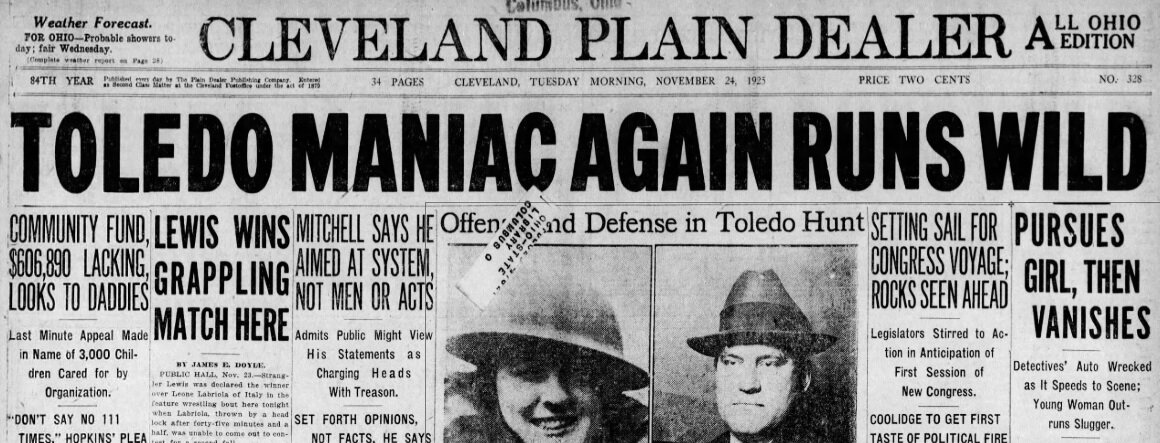
By Thanksgiving, the city fell into a panic, generating bold headlines across the nation. Toledo’s “maniac clubber” with a “hooked nose” and a “fiendish laugh” was too sensational for reporters to ignore.
At least four other women during the month of November said they too had been victims of the “Clubber,” although police were quick to dismiss many reports as nothing but hysteria.
As police took to the streets by the hundreds, an army of citizens joined in the search. The American Legion even put 500 of its members on patrol to escort any woman walking alone.
Through the holidays no new reports of attacks surfaced, but still, the city was on edge. If there was any hope that the New Year might bring a close to the deadly brutality of the “Clubber,” that hope faded quickly.
In January of 1926, the ax murder of Mrs. Mary Handley brought a new sense of panic to the city. Her bloodied and beaten body, found on Woodland Avenue near her home, would prompt Toledo Safety Director Art Hill to call for the hire of 25 more officers and the purchase of additional squad cars for the city’s police.
Strangely, after January, the attacks stopped. For reasons perhaps known only to the “Clubber” himself, the Handley murder was the last attack for months. The spring and summer months of 1926 moved through their normal paces and the sensational “Clubber” stories in the newspapers vanished — replaced with routine stories of human experience. The women of Toledo were beginning to breathe a sigh of relief.
But the anxious calm was shattered in the fall of 1926. On the morning of Oct. 26, the naked and bloodied body of a young schoolteacher, Lily Croy, was found by her brother outside of Washington School near Palmwood and Wheeler. The 26-year-old Croy was studying to be a missionary and had been walking home from her night classes at Toledo University, then located on 11th Street downtown. Police think she was attacked near the school, then bludgeoned to death with a hunter’s ax.
Police action was immediate, calling in all officers for duty. Their mandate was to find this “Clubber” and get him off the streets.
This brought the total death count to four, and before the day was over, another woman would be on the front pages: Mrs. Mary Ann Alden, 47. Her body was found by her husband in their home, not far from the morning’s murder, on 14th Street. This time, it was gunshots that had dealt the sting of death.
Was this the work of the “Clubber?” That possibility loomed large, but the M.O. didn’t seem to fit.
Alden’s husband thought a male roomer may have killed her. Police eventually found the man but didn’t have enough evidence for an indictment. Ultimately, this case also grew cold, and Mrs. Alden’s murder was never solved, as investigators debated amongst themselves as to whether she was a victim of the “Toledo Clubber” or someone with a specific motive.
At the time, $12,000 in reward money was offered for information about all the murders, inspiring a glut of tips and leads. Most of these were useless, as were the slew of individuals who came forward to allegedly confess. They all eventually were tossed aside as feeble attempts to garner attention.
One confessor was taxi driver Charles Hoppe, an accused child killer. Hoppe told police he also killed schoolteacher Lily Croy. His confession, coming just days after he had been arrested for the kidnapping and murder of seven-year-old Dorothy Sielagowski in Toledo, was given in May of 1928.
The public was ready to hang Hoppe, but his “Clubber” confession was readily dismissed by detectives. However, Hoppe did eventually “hang,” as he was convicted and executed for the abduction and murder of the young Sielagowski.
As weeks and months progressed, scores of men were rounded up and hauled into the Safety Building for questioning. Many of them were so called “morons” or “mental defective” types, as detectives thought only an outwardly insane person could be capable of such heinous crimes. The search would span several states, and several “strange” men became of special interest to the police. But in the end, there was never enough evidence to charge a suspect.
By 1927, the killings and attacks had ceased — and so too the newspaper headlines — but the fear and the stories did not.
While the case has grown “cold,” a century later, this unsolved “Clubber” case has gotten a second life as Internet and social media sleuths speculate on possible suspects and motives.
One theory still bandied about is that perhaps the mystery “firebug,” who was setting fires around the city in the same time frame as the murders, might also have been the “Clubber.” Or perhaps even the person who had been poisoning animals at the zoo. Both of these cases also remain unsolved.
The truth will likely never be known. The killer, cops, witnesses, and victims have all long departed this earth. But still alive is a frightening tale of a time of terror that will forever haunt Toledo history.